
|
| Bio | Contact | CV | Family History | Friends | Home | Performance | Projects | Text | Works |

|

Journeys: An exhibition Inspired by the OdysseyFor 2,700 years Homer’s Odyssey has spoken to us of the human spirit and of human frailty. It has passed from one generation to the next, first sung by storytellers, later transcribed into written language. The text has been interpreted and translated, and reinterpreted and retranslated over the centuries. It survives as a story of wondrous adventures and as a vehicle of metaphor for the innumerable journeys that define any life. Most of all, as Odysseus has become part of all that he has met, all that he has met has become a part of us. The lessons of the Odyssey are so ingrained in Western thought that its influence has become transparent to us. 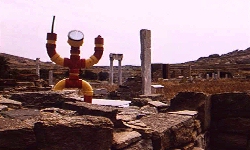
For Peter Terezakis, a New York-based artist, Homer’s Iliad and the Odyssey came to him as they came to us through time. The poems were first spoken to him as bedtime stories of adventure related by his father, a Greek Orthodox priest. Terezakis came to the text later. As the artist himself travels through life experiencing love and loss, as well as the complexities of the quotidian, he finds that Odysseus’ choices reveal even more profound truths, as well as a framework for examining one’s life. Here Terezakis exhibits one of his series of ὀδοιπόροι — literally, pilgrims or travelers — sentinels constructed from PVC pipes and painted in bright reds and yellows, as though to give warning. His ὀδοιπόροι contain passages of the Odyssey recorded on silicon chip; powered by solar collector, they broadcast their messages at timed intervals. 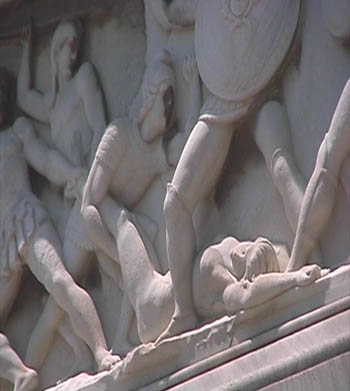
He has left small versions of his wayfarers in various locations; one at his father’s grave calls out all the words he knew for father. Starting in the spring of 1998 he has placed ὀδοιπόροι in Greece, on Delos, Therassia, Piraeus, in Athens, and even floating between some of the islands. Although theirs is a singular voice, the repetition of the message, about every six or seven minutes, suggests a classical chorus. But the ὀδοιπόροι also suggest small voices from the wilderness, waiting for us to be still enough to hear their messages, and to be ready to receive them. Terezakis observes that it is only when Odysseus has been battered by life and loses strength that he truly gains the wisdom to be a more just ruler, and a better husband and father. The ὀδοιπόροι (1999) created for this exhibition acknowledge that this is a difficult lesson for the young and untested to accept, but an important one to hear. An excerpt of this radio-wave transmitted message follows. Of all that breathes and crawls the earth, 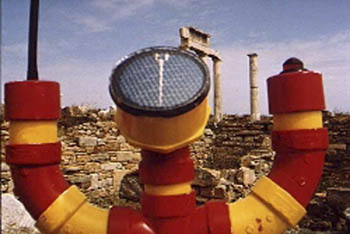
J.M. Welker, October 1999 The exhibition was funded, in part, by a grant from the Pennsylvania Council on the Arts, a state agency funded by the Commonwealth of Pennsylvania and the National Endowment for the Arts. Michiko Okaya, Curator 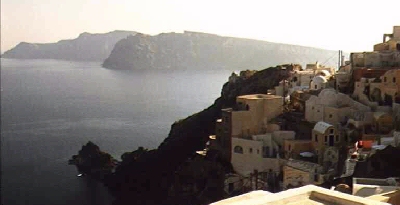

|
|